
Posted on 7/30/26, 3:35 PM
Last month we listed the top eight surgical robots and the companies that make them mainly according to number of units sold and the number of procedures they performed—this month we again list those top eight while adding 12 surgical robots to the list. This top eight ranking is slightly different from last month's ranking due to the input of additional sources.
Still the Champ Among World-class Competition
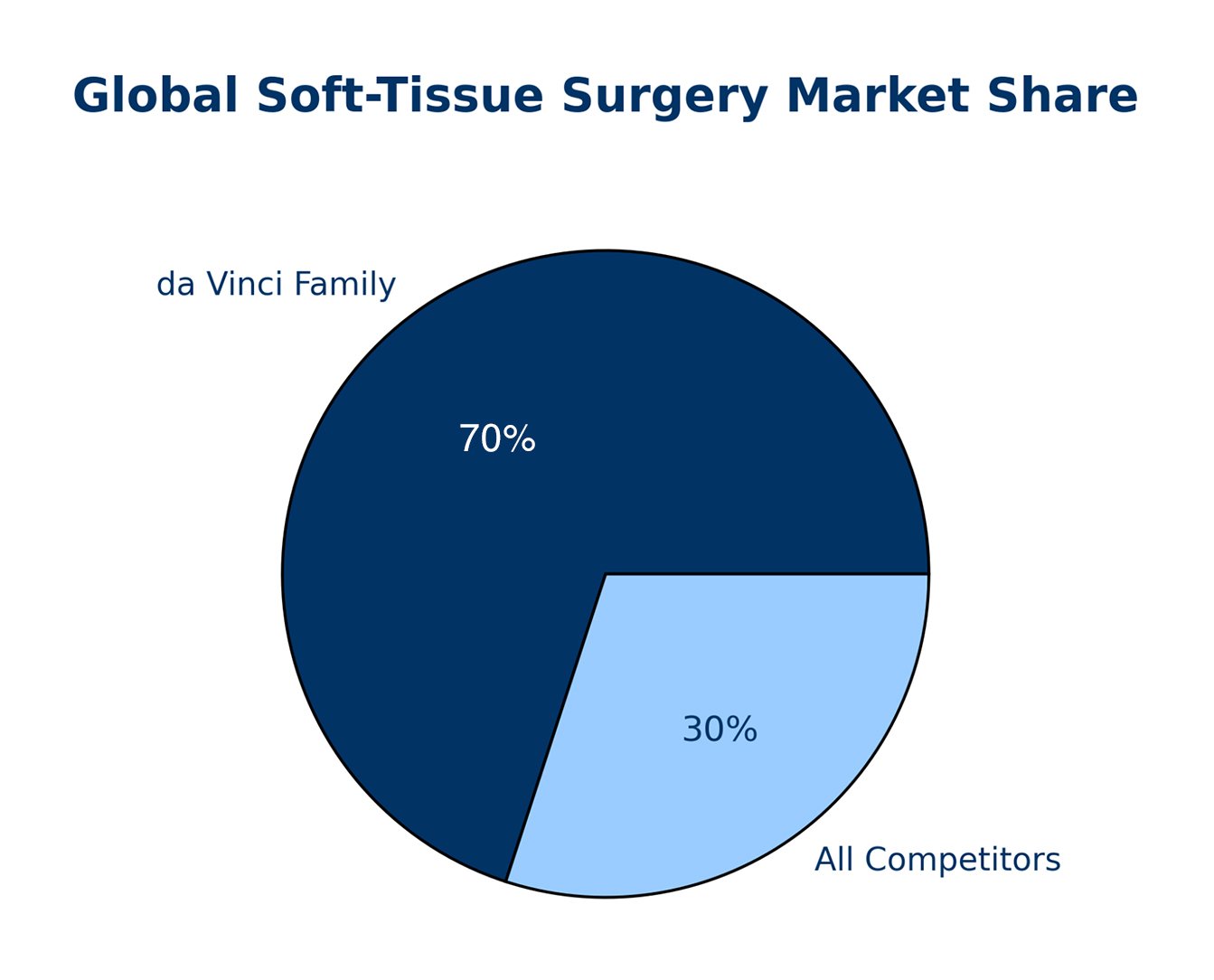
Intuitive Surgical’s da Vinci 5 (plus previous versions Xi and SP) dominates the soft-tissue surgery category with nearly a 70% global market share, and roughly 12,000 systems installed worldwide performing over 20 million procedures. Intuitive's da Vinci 5 uses state-of-art sensors near the tips of its cutting and pulling instruments to deliver real-time force feedback (haptic), which can reduce tissue pull-tear force by up to 43% compared to rival systems.
However, the da Vinci price tag can cause sticker shock for many rural and inner-city hospitals and clinics. These medical facilities may instead choose a mobile robot with a surgical arm and a cart with an open console; such a robot might be shared by rural county hospitals where mobility and expedience are key. These are exceptional standalone robots without the bells and whistles of a tower system like the da Vinci. However, da Vinci's reputation in real-world surgeries and procedures speaks for itself. However, da Vinci's competition is also improving.
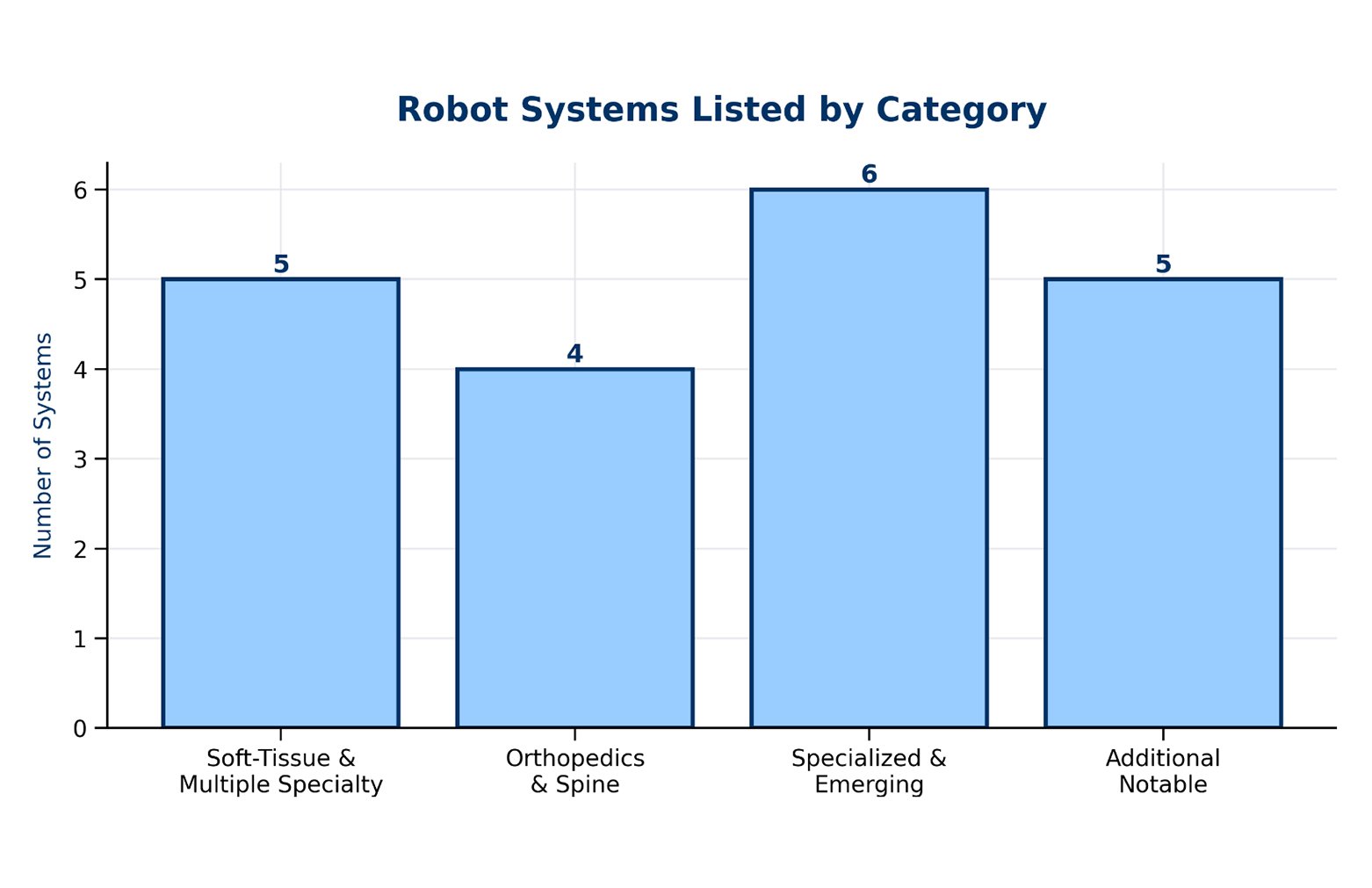
Soft-Tissue & Multiple Specialty Robots
- Da Vinci 5/Xi /SP (Intuitive Surgical, U.S.). The market leader for laparoscopic and minimally invasive procedures (general surgery, urology, gynecology, thoracic, etc.). Advanced features like force feedback is used in the latest model; a massive base of nearly 12,000 systems installed worldwide.
- Hugo RAS (Medtronic, Ireland/U.S.). Modular, open-console challenger to da Vinci 5. Gaining traction in urology and expanding; first major U.S. clearances in recent years.
- Versius PlUS (CMR Surgical, UK). Portable, modular system designed for flexibility and lower cost; mostly Europe/Asia, but expanding into the U.S. with cholecystectomy clearance.
- Ottava (Johnson & Johnson MedTech, U.S.). Upcoming unified platform (in late-stage development/FDA review); leverages Ethicon instruments for general surgery.
- Senhance/Luna (Asensus Surgical). Digital laparoscopy with force feedback and AI elements; more affordable alternative.
Orthopedics & Spinal Robots
- Mako SmartRobotics (Stryker, U.S.). Dominant in joint replacements (knee, hip); Uses 3D modeling and haptic guidance. Over 4,000-5,000 installations.
- ROSA Robotics (Zimmer Biomet, U.S.). For knee, hip, and spine procedures; part of a broader digital ecosystem.
- Excelsius GPS (Globus Medical, U.S.). Spine-focused with high precision for pedicle screw placement.
- CORI/NAVIO (Smith+Nephew, UK). Handheld/compact orthopedic robotics for knee procedures.
Specialized & Emerging Systems
- Ion (Intuitive Surgical, U.S.). Endoluminal system for robotic bronchoscopy/lung biopsies; strong adoption in pulmonology.
- Monarch (Johnson & Johnson/Auris Health, U.S.). Flexible robotic platform for bronchoscopy and urology.
- Toumai (MicroPort MedBot, China). Multi-port laparoscopic system; growing domestic and international presence.
- Tianji (Tinavi China). Orthopedic robot with strong China market share.
- Dexter (Distalmotion, Switzerland). Compact, collaborative system for hernia and other procedures; targeting ambulatory settings.
- Maestro (Moon Surgical, France/U.S.). Lightweight, dual-arm assistant for laparoscopy; focuses on copilot role.
Additional Notable Systems
- Hinotori (Medicaroid, Japan). Multi-port system popular in Japan; remote surgery capabilities.
- Revo-I (Meerecompany, South Korea). Early Korean laparoscopic robot.
- Senhance expansions or Ssi Mantra (SS Innovations, India). Cost-effective options for emerging markets.
- Anovo Hominis (Momentis Surgical, Israel). For gynecological procedures.
- Galaxy (Noah Medical), Mazor X (Medtronic spine).
Surgical Robots Worldwide
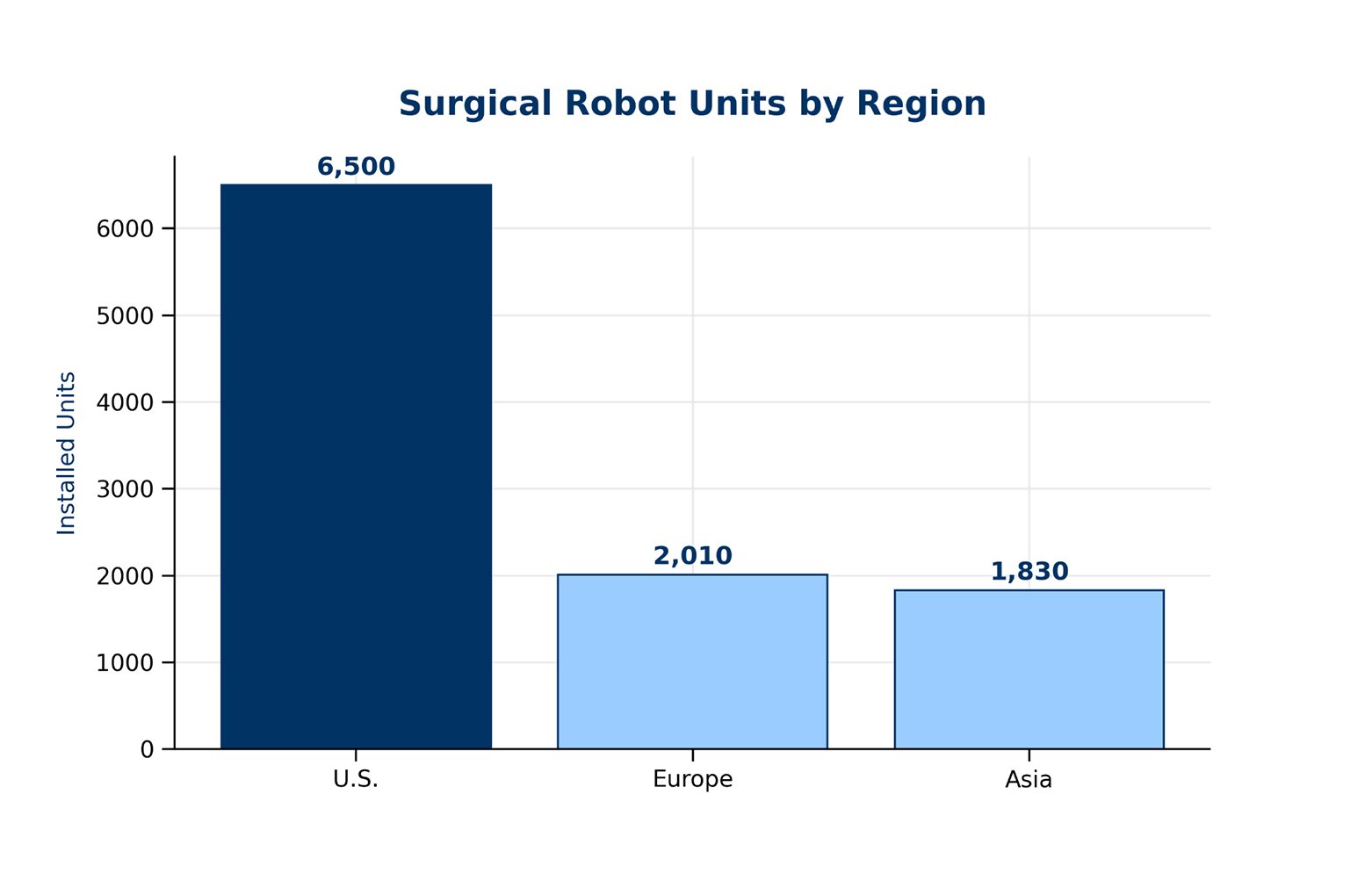
The U.S., with roughly 350 million people, is currently home to two-thirds of the world's surgical robot population (65-70%). When considering that 450 million people reside in the European Union (27 countries), and nearly 750 million populating the whole of Europe, one would assume at some point that Europe might make a run at surgical robot supremacy.
The number of surgical robot units presently in the U.S., Europe, and Asia respectively: 6,500, 2,010, and 1,830. And yet the inverse is true when it comes to industrial robot density, with China, Japan, and Germany at the top and the U.S. coming in at fourth. Governments choosing surgical robots over industrial robots and vice versa is a case study on its own. However, data from various healthcare systems around the world is a prime mover relating to surgical robot density.
Sources: arthroplastytoday, sciencedirect, CIHI, texashealth, Standardbots, Kingsfund, Commonweathfund, Medtechdive, Archive.ourworldindata.
The Interpower® Solution
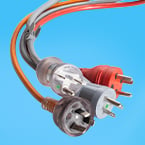 Interpower North American and Japanese hospital-grade plugs and receptacles bear the green dot, signifying they have passed the rigorous UL 817 Abrupt Removal Test (UL 817, 18.2.4.1) for hospital-grade cords—the three Interpower conductor wires inside the molded hospital-grade plug are anchored by a stainless steel ring that ensures electrical continuity whenever you need AC power in critical medical settings.
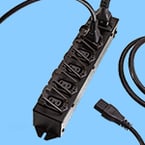 Interpower also offers its popular Accessory Power Strip with up to ten outlets to allow IEC 60320 connectors, plug connectors, inlets and outlets to power multiple medical devices such as surgical robots, portable CT scanners, X-ray machines, and treadmills—all with the correct amperages and voltages.
- 1-week U.S. lead times
- In-stock products ship the same day
- Blanket & Scheduled orders available
- Customized barcoding and labeling options