




Posted on 11/25/26, 1:39 PM
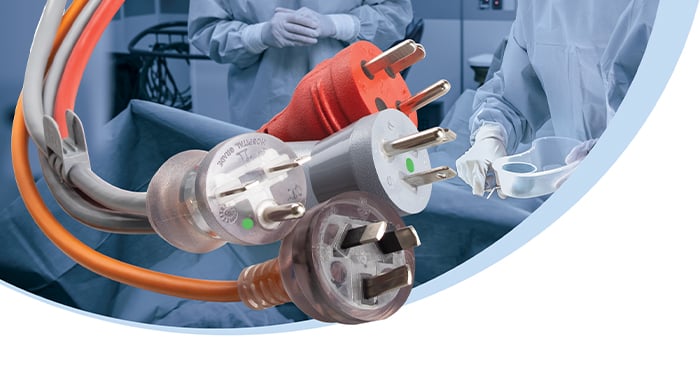
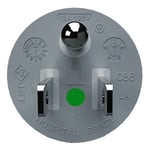
For over a century, AC power has played a vital role in the welfare of patients and staff in hospitals and clinics worldwide. Hospital-grade power cords are manufactured to higher standards to ensure the correct amperages and voltages power a broad range of medical equipment—portable CT Scanners, X-ray machines, heart monitors, hospital-grade treadmills, surgical robots and more. Hospital-grade plugs bear the “green dot,” signifying they meet the stringent medical cords standards. North American (NEMA) 5-15, 5-20, 6-15, and 6-20 hospital-grade molded and hand-wired cords meet UL 817 requirements as well as others, and the Japanese hospital-grade cords meet the JIS 8303 standard.
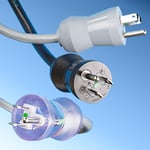 |
North American (NEMA) 5-15 |
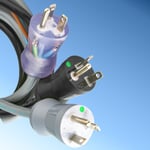 |
North American (NEMA) 5-20 |
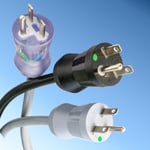 |
North American (NEMA) 6-15 |
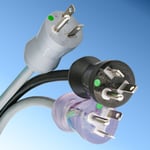 |
North American (NEMA) 6-20 |
 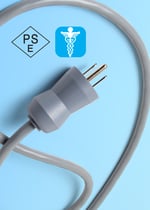 |
Japanese Hospital Grade |
Worldwide agencies such as UL, VDE, JET, and CSA, publish demanding standards for power cords, as do country-specific government agencies that often publish separate sets of standards which may pertain to certain metals and resins used in their “approved” electrical designs.
Hospital-grade . . . Testing, Testing.
When it comes to testing power cords, not all manufacturers test cords after each stage of the latter’s production. Consider the power cords sold at big box stores. A reasonable assumption is that a certain percentage of them would most certainly struggle to pass the strenuous UL 817 Abrupt Removal Test. Why? Quality control issues, inferior raw materials, and fewer batch and individual cord testing, especially in certain Asian countries where cords are produced by the millions and working conditions are poor and worker strikes are common.
The Interpower Ring
The UL 817 Abrupt Removal Test: where a plug is inserted into a socket and at the end of the cord a 10-lb weight is attached and then dropped abruptly to see how far the blades have bent, and to see if the wires have lost electrical continuity, e.g., the crimps are destroyed and one or more conductor wires have been pulled free of the plug, or the blades and pins are bent or broken. These are “fail” examples. At Interpower, any failed test leads to an in-depth examination as to why it failed.
| The retention rings (image right) inside Interpower’s molded hospital-grade cords are made of stainless steel which clamp around the three conductor wires to ensure electrical continuity and keep the crimped conductors solidly in place. In the medical space as far as machines and devices go, electrical continuity is everything. | 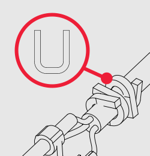 |
Another test is the Abrupt Pull Test which is a standard NEMA plug/cord (3-conductor cords) test, including hospital-grade cords. A 2 ½ pound weight is attached to the plug’s cord and dropped 25 times from the connected plug and socket. Before the initial drop, three lights on the test equipment glow red showing electrical continuity. However, during the test, if one of the three wires fail (line, neutral, and ground) and one or more lights go out, the test is considered a failure. If that occurs, the plug is examined to see why the continuity was broken.
Hospital-Grade Standards Overview
Country-specific agencies such as UL create and update safety standards through testing methodologies enhanced from existing household cord standards, i.e., what metals and resins should be used for the more robust hospital-grade plugs? What lengths should their blades and pins be? What are the amperage and voltage rating of the cord set? Besides their own agency standards, countries may also recognize IEC standards. Countries that do not use hospital-grade standards use their existing household cord standards for medical equipment and devices.
Australia:
In Australia, for example, hospital-grade cords must meet AS/NZS 3200 standards, and for plugs AS/NZS 3112. An Australian rewirable 3-pin plug must be clear or “see-through.” For molded plugs clear or colored is optional. The preference for many Australian hospitals is orange cable attached to a clear plug.
Denmark:
Danish hospital-grade cords, plugs, and sockets in medical applications are under their SB 107-2-D1 standards. The socket is designed to prevent non-hospital-grade plugs from connecting and disrupting the main circuit in medical settings. The preferred color for hospital-grade cord sets in Denmark is red.
Japan:
In Japan, cord plugs and sockets must carry the “PSE” approval mark under DENAN, a Japan Ministry of Economy, Trade and Industry (METI) mandate. Noteworthy is that Japan has two frequencies. The Fuji River is used as a basic geographical reference point for the two frequencies: on the eastern side (Tokyo, Yokohama) 50 Hz is used; on the western side (Osaka, Kyoto, Hiroshima) 60 Hz is used. Europe mainly uses 50 Hz, and the U.S. uses 60 Hz. Typically, frequencies aren’t mentioned much in the standards as a whole, whereas an emphasis is put on amperages and voltages.
European & Non-European Countries
EN 60601 is the Medical equipment standard for European countries. Non-European countries follow the IEC 60601-1 medical standard (except for China, Korea, and Japan). There are over 100 medical equipment standards in IEC 60601. The most general and inclusive is IEC 60601-1. Subsequently, IEC 60601-2 through IEC 60601-118, focus on individual medical equipment and apparatus.

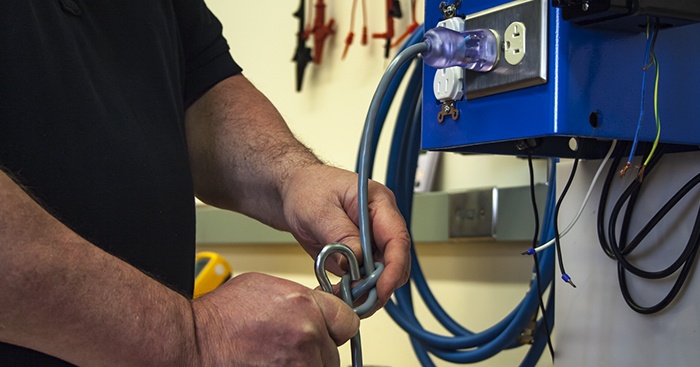
Hospital-Grade Cords Made Safer With Cord Clips!
Despite the universe of resin compounds listed on UL’s website, sometimes finding the perfect resin with the right additives is challenging, especially when mixing resin compounds with nonresinous material. Interpower’s cord clip can be molded onto 3 x 16 and 3 x 18 AWG cords as well as the 3 x 18 VCT-F Japanese cords, and is constructed of a glass-reinforced Polypropylene resin compound to ensure molding consistency and optimal retention.

Interpower’s cord clip strikes a balance between cord retention strength and ease of insertion force.The cord clip resin is considered a stable thermoplastic with no chemical reactivity under normal ambient or anticipated temperatures and pressures. Interpower cord clips can be used in a wide range of markets such as Industrial, Information Technology, Appliance, Medical, Food Service—anywhere excess cable could pose an issue or a danger. Interpower utilized customer surveys to determine the correct material and product design that would meet their needs.The clip is set at a convenient 4.75 inches behind the plug as an optimal distance after much experimentation and testing. The clips come in gray and black and are made in the U.S.A.
Cord clips help prevent injuries—there’s no cord to trip over, and less stress on hands, arms, and back from pulling and holding the weight of slack cord when used with handheld tools such as sprayers. It also extends cord life by keeping it away from machinery preserving the jacketing by allowing less drag. It also minimizes the chance of excess cord catching on objects and surfaces, which may cause disconnections or bent plug blades.
